
The Monocab is a self-balancing autonomous cabin that runs on one rail of a disused railway line.


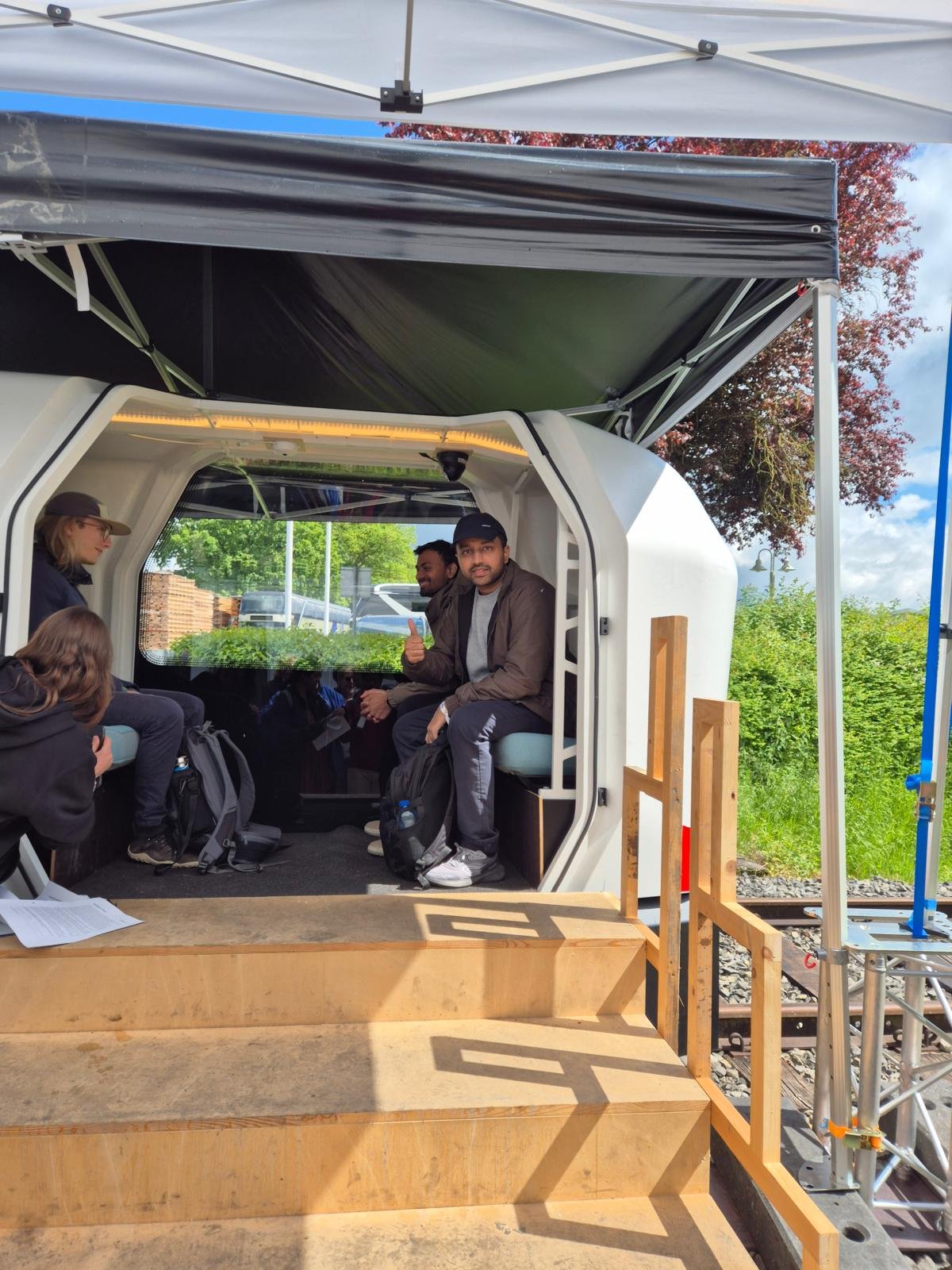
The one I rode was not balancing itself, was not autonomous, and was not on a railway line. The gyroscopic system was switched off. A support rail had been fitted so the cabin could not tip. A man was driving it manually. We were indoors, in a warehouse.
I want to be fair to the team, because they were completely upfront about all of this before anyone got in. Safety comes first with a prototype and nobody was pretending otherwise. But it does mean that the demonstration I travelled to Lemgo for demonstrated almost none of the things that make the vehicle worth discussing.
I have thought about it more since than almost anything else I saw this year.
The asset nobody counts
Here is the thing that changed how I look at rural transport.
When a country builds a new transit line, the vehicle is rarely the expensive part. The expensive part is the corridor. Somebody has to acquire the land, survey it, grade it, drain it, bridge the rivers and cut through the hills. That work takes years and consumes most of the budget before a single passenger is carried.
Germany did all of that already, decades ago, across an enormous rural network. Then car ownership rose, people moved to cities, the lines stopped paying for themselves and they were shut. What is left in a lot of places is a corridor that is still graded, still drained, still bridged, with rails on it, overgrown and doing nothing at all.
On the national balance sheet that infrastructure counts as closed. In physical reality it is mostly still there.
The Monocab project is what happens when somebody looks at that and asks a different question. Not “can we restart the trains,” because the answer to that is no, the passenger numbers do not exist and never will. The question instead is what kind of vehicle would make sense on a line that only needs to carry a handful of people at a time.
That reframing is the innovation. The pod is the consequence.
Two directions, one track, no rebuilding


Once you accept the premise, the engineering starts making sense.
A conventional railway has two rails and a train sits across both of them. The Monocab runs along a single rail, which means the other rail is free for a vehicle travelling the opposite way. The cabins are narrow enough to pass each other on a track that was built for one train at a time.

That is a lot of capacity to unlock without laying anything new. Rural single-track lines have always had a scheduling problem, where a vehicle going one way blocks the whole line until it clears a passing loop. Running each direction on its own rail deletes that problem instead of managing it.
Each cabin seats six and takes a wheelchair. The vehicle is electric, which matters less for emissions here than you might think, because a light vehicle running occasionally was never going to be the climate story. What matters is that the thing is light enough to run on track that could not carry a train, and on curves a train could not take.
The part that is genuinely hard
Take one rail away from a rail vehicle and you have created a real physics problem.
A train is stable because it sits on a wide base and gravity does the work for free. Balance the same mass on a single line of contact and nothing is free any more. The cabin now needs to actively hold itself upright, continuously, with passengers moving around inside it and wind pushing on the side of it.

The Monocab does this with reaction disks. They are mechanical gyros mounted inside the vehicle, spinning fast, and by changing their orientation the system generates a counter-torque that pushes back against the cabin tipping. It is the same principle that keeps a spinning bicycle wheel upright when you hold it by the axle, scaled up and put under active control.
This is elegant and it is also the single riskiest part of the whole concept. A gyroscopic stabiliser has to work every second the vehicle is occupied. It consumes power continuously, it has to reject disturbances it has never seen before, and unlike almost every other subsystem there is no graceful version of it failing.
Which brings me back to the support rail on my ride. I understand entirely why it was there. But the support rail is the thing standing between this project and being real, and no amount of admiring the cabin design gets around that.
Why on-demand is the right model
Rural public transport usually fails for a reason that has nothing to do with technology.
A bus route runs on a timetable set in an office. It runs whether four people board it or nobody does. Because running it costs the same either way, the operator thins the schedule until the service is too infrequent to plan a day around, at which point everybody who can afford a car buys one, ridership drops further, and the route gets cut. In most small communities the honest choice is a car or nothing.
An on-demand fleet breaks that loop. Cabins move when somebody requests them and sit still when nobody does, so serving twelve passengers a day costs roughly what serving twelve passengers a day should cost. Low density stops being a reason the service cannot exist.
That is the argument, and I find it convincing. It is worth saying that on-demand rural transit has been tried in other forms and the results have been mixed, mostly because the economics of the vehicle and the driver never quite worked out. Removing the driver is what is supposed to close that gap here. It is also, conveniently, the hardest thing on the list.
The forms we signed
Before boarding, we signed consent forms. Cameras inside the cabin record passenger faces during the ride, and the footage feeds an AI system studying comfort and reaction.
Nobody in the group objected, myself included, and for a research prototype it is a reasonable thing to do. But it is worth noticing what the deployed version of that idea looks like. An unstaffed autonomous cabin will almost certainly need interior cameras anyway, for safety and for incidents, because there is no driver to notice anything. So the finished system plausibly involves rural residents being filmed inside a vehicle with nobody else aboard.

That is not a reason to abandon the concept. It is a design question that deserves an answer before deployment rather than after, and I do not think the project is the wrong place for that conversation to start.
What could still stop it
The corridors may not all be there. The entire premise rests on usable track. Rails get lifted for scrap, corridors get built over, embankments wash out. A cheap vehicle sitting on a line that needs a full rebuild is not a cheap system.
Coordination is now safety critical. Two vehicles sharing a track by using different rails is elegant until the software that keeps them apart has a bad day. That coordination layer has to be designed with redundancy from the beginning.
Trust takes longer than engineering. The people this is built for skew older, and asking them to step alone into a driverless pod is a genuine ask. Pilot phases, visible local engagement and remote human operators will be needed for years after the technology stops needing them.
Nothing in transit law is shaped like this. It is not a train and not a tram. Certification, liability and data governance all sit in the gap between categories, and the cameras make the last one sharper.
Beyond Germany
The conditions the Monocab responds to are not uniquely German. Parts of Eastern Europe have the same combination of thinning rural populations and rail corridors that stopped paying their way, and the concept would transfer there with little conceptual change.
The Global South is a harder case. Light and low-cost systems are attractive precisely where budgets are thin, but an app-dispatched autonomous vehicle assumes reliable power and reliable connectivity, and both assumptions do a lot of quiet work. A stripped-back version, solar powered, dispatched by a person rather than an algorithm, would be a different vehicle serving the same idea. Possibly a more useful one.
What I actually took away
The prototype I saw was early. It rolled along a support rail with its gyros off and a human at the controls, and calling that a demonstration of autonomous single-rail transport would be generous.
But the idea underneath it does not depend on the pod at all. It depends on noticing that a country can spend a century building infrastructure, walk away from it, and then forget it still exists. Every abandoned line is a corridor somebody already paid for.
Working out what should run on it now is a smaller problem than it looks, and a more interesting one than building something new.
All photographs by the author.



Leave a Reply